CMC Klebetechnik enhances films, fabrics, nonwovens, and paper with custom coatings, transforming them into functional materials for demanding applications. We support our customers as development partners – from the initial idea through pilot testing to mass production using a roll-to-roll process.
- When Material Alone Isn’t Enough
2. What Is Contract Coating?
3. Roll-to-Roll Coating – What’s Behind It?
4. When Is Contract Coating Worth It?
5. How Does a Coating Project Work at CMC?
6. What Materials and Systems Are Used?
7. Technology and Key Metrics at a Glance
8. Why Process Losses Should Be Included in Cost Estimates
9. Strip Coating—When Full-Surface Coating Isn’t the Best Solution
10. From Coating to Ready-to-Use Delivery
11. Environmental Considerations: Sustainability Built In
12. FAQ
13. Conclusion: Thinking of Coating as a Development Partnership
When Material alone isn’t enough
Inadequate adhesion, unsuitable release properties, lack of temperature resistance, or additional requirements such as electrical or thermal conductivity. This is exactly where we come in.
Through targeted coating, we make flexible web materials such as films, fabrics, or nonwovens functional – exactly as the application requires. We see ourselves not only as a manufacturer but as a trusted partner who combines material expertise, experience, and process technology.
In this article, we’ll show you:
• what defines industrial roll-to-roll coating
• when contract coating makes sense
• how we support customers from the initial idea through to production readiness
What is contract coating?
In our contract coating service, we coat flexible web materials on behalf of our customers—using film, coating material, or both, as requested.
The advantages are clear:
• No investment in in-house equipment
• No additional process or personnel resources
• Reproducible quality
• Fast development cycles
• Cost-effective production even for small quantities
This is often the more efficient and significantly faster approach, especially for specialty applications.
Roll-to-Roll Coating – What’s Behind It?
In this industrial process, a functional layer is precisely applied to a substrate. CMC Klebetechnik draws on more than 60 years of experience in this field.
Three factors determine the result:
1. Substrate
Films, fabrics, nonwovens, or paper
2. Coating material
Adhesives or specialty compounds
3. Process parameters
Speed, drying, pretreatment, and more
Only when all factors work together perfectly can a solution be created that performs consistently not only in testing but also in mass production.
When Is Contract Coating Worth It?
Many companies opt for contract coating when they lack in-house development capabilities, face production bottlenecks, or do not have the necessary equipment. However, it is often a strategic decision as well: In-house teams focus on core competencies, while coating is handled by a specialized partner.
In our experience, contract coating is particularly beneficial when:
• specific material combinations or functions are required
• rapid iterations are needed during development
• small to medium quantities need to be produced cost-effectively
• reproducible quality and reliable documentation are important
• the path to series production needs to be shortened
In these cases, our customers can provide the substrate, the coating compound, or both. Additionally, coating trials are possible, in which equipment and personnel are specifically utilized for development purposes.
How does a coating project work at CMC?
Turning a material concept into a production-ready solution requires more than just the actual coating process. The key lies in the interplay between the application, the material, the coating substance, and subsequent processing.
This is precisely where we support our customers as a trusted partner for coatings. Together, we assess requirements, develop initial samples, validate suitable parameters, and gradually transition successful approaches into near-production manufacturing.
To turn an idea into a production-ready product, we guide the entire process:
1. Initial Sampling & Technical Clarification
• Aligning requirements and the target specification
• Initial A4 samples for preliminary evaluation
2. Laboratory & Pilot Phase
• Testing process parameters
• Evaluating variants
• Producing larger samples under realistic conditions
3. Transition to mass production
• Sample production on the large-scale production line
• Validation and subsequent mass production delivery
In this way, we support not only the coating process itself, but also the path toward a solution that can be reliably integrated into the customer’s production process.
What materials are used?
Wir beschichten eine große Bandbreite flexibler Materialien, z. B.:
- Polyester, Polyimid, Aramidpapier
- PTFE, ETFE, PEN, PPS, PEEK
- Kupfer- und Aluminiumfolien
- Glasgewebe, Nonwovens
Typische Beschichtungssysteme:
- Acrylat-, Silikon-, Kautschuk- und Heat Seal-Klebstoffe
- PU- und Polyesterharz-Klebstoffe
- Spezialcompounds wie leitfähige Silikone, Latex oder 2 K Systeme
Jedes System wird so gewählt, dass es exakt zur Anwendung passt.
Begriffs-Quickcheck:
2K-System: Ein Zwei-Komponenten-System, das erst durch das Mischen reagiert beziehungsweise aushärtet.
100%-System: Ein System ohne Lösemittel- oder Wasseranteil. Die aufgetragene Masse bleibt vollständig als Schicht erhalten, anstatt während der Trocknung Anteile zu verlieren.
Hinweis: Genannte Markennamen dienen nur als Materialbeispiele. Die Markenrechte liegen bei den jeweiligen Inhabern.
Technik & Kennzahlen im Überblick
Isolationssysteme haben für Produzenten von Komponenten ein erhebliches Einsparungspotential, wenn es darum geht, an Kunden oder in Länder zu liefern, die eine UL-Zulassung fordern. Durch Verwendung nur UL-gelisteter Bestandteile (Spulenträger, Tränkharz, Lackdraht, Isolationsklebeband) z.B. für einen Übertrager kann die Zulassungsprüfung deutlich vereinfacht und vor allem verkürzt werden.
Isolationssysteme fassen erprobte, durch den z.B. Sealed-Tube-Test geprüfte Isolationsmaterialien zusammen.
Mehrere Elektroisolier-Klebebänder von der CMC Klebetechnik sind in den folgenden Isolations-Systemen (Klasse B/F) der Firma Du Pont freigegeben
- Class 130 Crastin® PBT, Mylar®, Nomex®, Herberts® Electro C190HE
- Class 155 Crastin® PBT, Mylar®, Nomex®, Herberts® Electro C290HE
- Class 130 Rynite® PET, Mylar®, Nomex®, Herberts® Electro R150HE
- Class 155 Rynite® PET, Mylar®, Nomex®, Herberts® Electro R201HE
- Class 155 Rynite® PET, Mylar®, Nomex®, Herberts® Electro R203HE
- Class 155 Zytel®, Crastin® PBT, Mylar®, Nomex®, Herberts® Electro CZ255HE
- Class 130 Zytel®, Mylar®, Nomex®, Herberts® Electro Z130HE
- Class 130 Zytel®, Mylar®, Nomex®, Herberts® Electro Z150HE
- Class 155 Zytel®, Mylar®, Nomex®, Herberts® Electro Z200HE
Eine weitere interessante Internetseite für die Recherche nach Isolationsmaterialien finden Sie unter http://www.ul.com/database
Diese Seite beinhaltet eine umfangreiche Datenbank von Underwriter Laboratories der UL-gelisteten Isolierstoffe.
Zu den im EIS gelisteten Bändern gehören die Typen:
CMC 10966, 10820, 65120, 65100, 70100, 70110, 80725, 16100, 84170, 84160, 84150, 65768, 16701, 18102, 16700, 17713, 65767 (verwendete Materialien: Polyester, Nomex, Polyestervlies, Kapton, Krepp-Papier, Glasgewebe).
Es existieren sehr viele weitere Isoliersysteme mit Klebebändern der CMC Klebetechnik, die jedoch von einzelnen Kunden bei UL eingereicht wurden und nicht zur allgemeine Verwendung zur Verfügung stehen.
Technik & Kennzahlen im Überblick
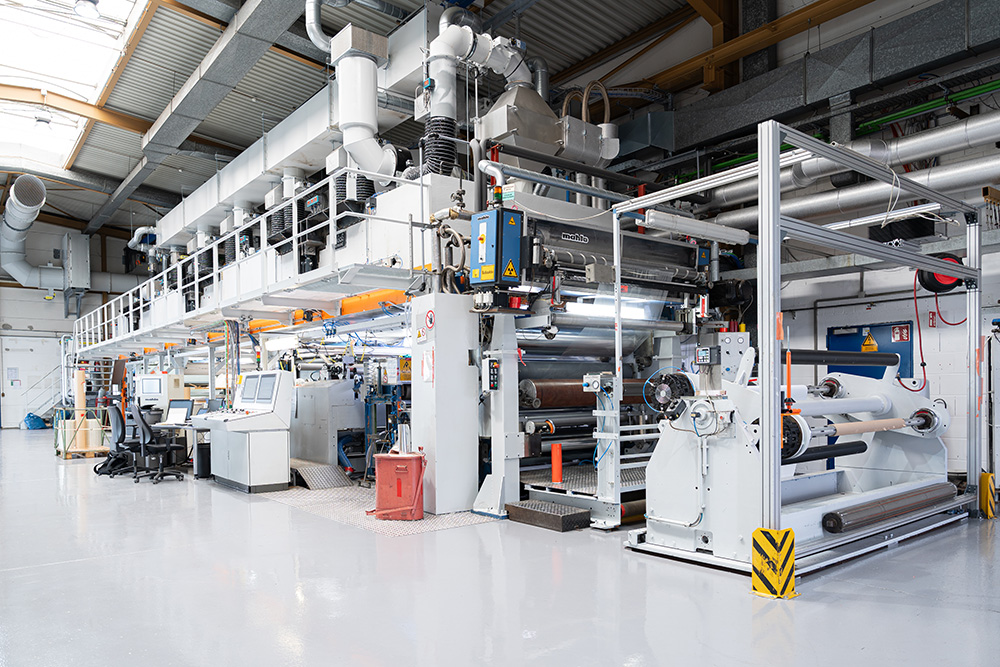
Für wasserbasierte und lösemittelbasierte Systeme stehen bei CMC zwei moderne Beschichtungssysteme zur Verfügung. Wir beschichten Breiten bis 1.900 mm und passen Prozessgeschwindigkeit sowie weitere Parameter an Produkt, Material und Qualitätsziel an.
| Parameter | Kennzahl |
|---|---|
| Anlagen | zwei Beschichtungssysteme |
| Max. Breite | bis 1.900 mm |
| Geschwindigkeit | bis 50 m/min (je nach Produkt/Qualitätsziel) |
| Auftragsgewicht | ca. 6 g/m² bis 2.000 g/m² |
| Trocknung | Heißluft |
| Max. Temperatur | bis 155 °C (auch zum Vernetzen) |
| Oberflächenaktivierung | Corona-Vorbehandlung |
Warum Prozessverluste in die Kalkulation gehören
In der Beschichtung gelangen nicht 100 Prozent der eingesetzten Materialien in das Endprodukt. Das ist kein Ausnahmefall, sondern Teil des realen Prozesses.
Typische Ursachen sind:
- Einfahrverluste
- technisch bedingte beschichtungsfreie Ränder
- Restmengen in Behältern
- Teilungsverluste beim Schneiden
Je nach Projekt sind 5–15 % Materialverlust realistisch und sollten eingeplant werden.
Durch standardisierte Anlaufprotokolle, gezielte Prozessparametersetzung und optimierte Vorrichtungen reduzieren wir Einfahrverluste messbar. Das spart insbesondere bei beigestelltem Material direkten Kostenaufwand für unsere Kunden und macht Angebote kalkulierbarer.
Streifenbeschichtung – wenn vollflächig nicht die beste Lösung ist
Für Nicht jede Anwendung profitiert von einer vollflächigen Beschichtung. Bei dünnen Folien kann Klebstoff beispielsweise herausgedrückt werden und unerwünschte Verklebungen verursachen. Bei Stanzteilen wiederum kann eine klebstofffreie Grifflasche das Handling deutlich erleichtern.
Für solche Anforderungen bieten wir Streifenbeschichtung an. Dabei wird der zunächst flüssige Klebstoff nur in definierten Streifen aufgebracht. Abstände und Breiten lassen sich anwendungsspezifisch anpassen.
Typische Vorteile:
individuell definierbare Streifenmuster
klebstofffreie Kanten, zum Beispiel für Finger-Lift-Lösungen
geringeres Risiko von Blocken oder Verkleben bei Lagerung
Von der Beschichtung zur verarbeitungsfreien Lieferung
Beschichtung ist in vielen Projekten nur ein Teil der Wertschöpfung. Deshalb ergänzen wir den Prozess bei Bedarf um weitere Schritte wie Schneiden und Stanzen.
Dank flexibler Systemtechnik können wir sowohl kleinere Aufträge ab 500 m² als auch großvolumige Serien wirtschaftlich abbilden.
Umweltaspekt: Nachhaltigkeit mitgedacht
Bei lösemittelbasierten Systemen ist der kontrollierte Umgang mit entstehenden Emissionen ein zentraler Bestandteil des Prozesses. Unsere Kunden profitieren davon, dass wir schädliche Emissionen im Prozess so weit wie möglich reduzieren.
Denn neben technischer Leistungsfähigkeit gewinnen auch Nachhaltigkeit und verantwortungsbewusstes Handeln in Unternehmen immer mehr an Gewicht. CMC verbindet beides: fundierte Beschichtungskompetenz und einen bewussten Umgang mit Umweltverantwortung.
Dass dieser Anspruch bei CMC auch auf Unternehmensebene verankert ist, zeigt die Auszeichnung mit der EcoVadis Bronze-Medaille. Damit gehört CMC zu den besten 35 % der weltweit von EcoVadis bewerteten Unternehmen. Berücksichtigt werden dabei unter anderem die Bereiche Umwelt, Arbeits- und Menschenrechte, Ethik sowie nachhaltige Beschaffung.