Preparation
Make sure that the surfaces to be bonded are clean, dry, and free of dust, grease, oil, or other contaminants. If necessary, thorough cleaning (e.g., with isopropyl alcohol) or even pretreatment (such as sanding or priming, depending on the material) may be required.
Temperature
The temperature of the adhesive tape and the surfaces should be within the optimal range for the tape being used (typically between 15°C and 30°C). Avoid extreme temperatures during application, as they can impair the adhesive strength.
Andruck
Sufficient and even pressure is essential to ensure that the adhesive can properly wet the surface. A pressure of approximately 20 N/cm² is generally sufficient to achieve good wetting and thus lay the foundation for a strong bond. Use appropriate tools for this, such as a pressure roller.
Zeit
Full final bond strength is often not achieved until after a certain period of time, typically within 24 to 72 hours. During this time, the adhesive flows into the microscopic irregularities of the surface and completely wets them. Avoid subjecting the bonded joint to heavy loads during this time. Low temperatures slow down the process of complete wetting of the bonding surfaces, while slightly elevated temperatures (e.g., 50–60°C) accelerate the process.
Processing Instructions for Special Products
More information on the processing of technical adhesive tapes
Surface Finish
The surface of the parts to be bonded must be dry, free of grease, and clean. A sign that a surface is not yet clean may be the formation of water beads when it comes into contact with water. In addition, the substrate must be solid for bonding. Remove any loose paint layers, etc., beforehand.
Mechanical Cleaning
Depending on the application and the base material, roughening the surface can increase the effective bonding area. The roughness depth must be significantly less than the thickness of the adhesive layer (to ensure good adhesion of the adhesive to the roughened surface).
Chemical cleaning
Grease, oils, and other release agents, as well as contaminants, can be removed with cleaning agents such as Acteon, toluene, isopropanol, and ethyl acetate. Before proceeding, it is essential to verify that the solvent being used is suitable for the material to be cleaned. When using these solvents, it is imperative to follow the manufacturer’s safety instructions.
Mild cleaners for removing adhesive residue
Solvent 50 Super (Kontakt Chemie), Order No. 812031-12 at Conrad, 92530 Wernsberg-Köblitz, Tel. 09604/408988 Protect cleaned surfaces from re-contamination (lint, fingerprints, etc.). Preferably bond immediately.
Surfaces with low surface energy
With nonpolar plastics such as polypropylene (PP), polytetrafluoroethylene (PTFE) (e.g., Teflon®), polyethylene (PE), rubber, and silicones, there are naturally problems when bonding them with standard adhesive tapes. Special adhesives are available for this purpose; please inquire with us about them. The surface should also be roughened chemically or physically (e.g., corona treatment).
Processing Temperature, Final Strength
The optimal application temperature is approximately 20°C. Bonding at temperatures below 10°C should be avoided. If there are excessive temperature differences between the parts to be bonded, condensation may form, which prevents proper bonding.
The adhesive tape should be applied with as much pressure as possible (depending on the material and workpiece). Adhesives are viscoelastic and flow into the irregularities of the substrate. For most adhesive tapes, the final bond strength is achieved after approximately 72 hours. This time can be shortened by applying controlled heat.
Heat-curing adhesives
Heat-curing adhesives are already largely resistant to impregnating varnishes as delivered. Subsequent heat treatment further stabilizes this resistance. Recommended temperatures: 1 hour at -150°C, 2 hours at -130°C, 4 hours at -100°C. In most cases, these adhesives can also be used without heat treatment.
PVC, plasticizer
Bonding with soft PVC is problematic because plasticizer diffusion can lead to a deterioration in the cohesion of the adhesive layer.
UV exposure, outdoor use
Not all plastics are suitable for long-term outdoor use in direct sunlight. Among technical films, polyester in particular can become brittle after several months of intense sunlight. We offer special types of adhesive tape for outdoor use. If you plan to use the product outdoors, please contact us and specify these conditions.
Impregnating varnishes, impregnating resins
Given the wide variety of different impregnating agents, it is not possible to make general statements. In particular, styrene-containing impregnating agents can be problematic. In many cases, the only solution is to conduct tests, which we would be happy to perform in-house using the samples you provide.
Back-side treatment
Back-side coatings or back-side treatments improve the unwinding performance of adhesive tapes. They prevent the adhesive coating from sticking to the back of the tape after storage. Virtually every self-winding adhesive tape on the market has such a release coating.
Information on Shelf Life and Storage
Due to their nature and chemical composition, our products generally have a limited shelf life or storability when unprocessed. Our warranty period is generally 12 months, but may be shorter in individual cases. However, most adhesive tapes can be stored for three to five years without any significant loss of quality, provided they are stored properly. Exceptions include, for example, fabric-backed adhesive tapes, which develop greater adhesion to the backing.
To ensure optimal workability, storage conditions must be strictly adhered to. This means that the adhesive tapes should be stored in their original packaging in a dry place at temperatures between 15–20 °C, away from direct sunlight.
Always store adhesive tapes in an upright position, as otherwise pressure marks may limit their workability.
Adhesive tapes intended for removable use (short-term applications) have shorter service lives, as the adhesive strength to the substrate increases with duration of use. The customer’s own tests are usually required to make a definitive determination. A few specific adhesive tapes or functional coatings have shorter service life. We would be happy to send you the corresponding technical data sheets upon request.
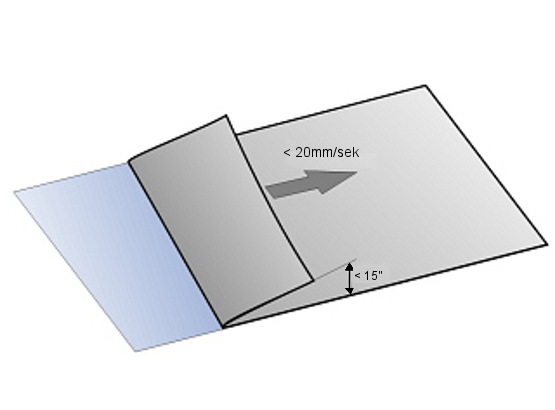
Removing the Cover (Liner)
Due to their nature and chemical composition, our products generally have a limited shelf life or storability when unprocessed. Our warranty period is generally 12 months, but may be shorter in individual cases. However, most adhesive tapes can be stored for three to five years without any significant loss of quality, provided they are stored properly. Exceptions include, for example, fabric-backed adhesive tapes, which develop greater adhesion to the backing.
To ensure optimal workability, storage conditions must be strictly adhered to. This means that the adhesive tapes should be stored in their original packaging in a dry place at temperatures between 15–20 °C, away from direct sunlight.
Always store adhesive tapes in an upright position, as otherwise pressure marks may limit their workability.
Adhesive tapes intended for removable use (short-term applications) have shorter service lives, as the adhesive strength to the substrate increases with duration of use. The customer’s own tests are usually required to make a definitive determination. A few specific adhesive tapes or functional coatings have shorter service life. We would be happy to send you the corresponding technical data sheets upon request.